Pilates for Weight Loss: The Honest Answer from a 10-Year Instructor
The most common question I get from new clients is some version of: Will Pilates help me lose weight? And the honest answer, after teaching for over a decade in Seoul, is more interesting than yes or no.
If you mean will the scale drop fast? — probably not from Pilates alone. If you mean will my body actually look and feel different? — yes, faster than most other forms of exercise. Those two outcomes are not the same thing, and the confusion between them is why so many beginners feel disappointed by Pilates around week three.
This is the conversation I have with every new client at mm Pilates before they sign a package, and I want to share it openly here.
How Many Calories Does Pilates Actually Burn?
A 50-minute Pilates class burns between 175 and 450 calories, depending on intensity, body weight, and whether you are on the mat or the reformer. That is a lower per-minute burn than running, cycling, or HIIT.
Here are the numbers I share with clients (based on a 70 kg adult, ACE/Harvard MET tables):
| Activity (50 min) | Approximate calories |
|---|---|
| Beginner mat Pilates | 175 |
| Intermediate mat Pilates | 250 |
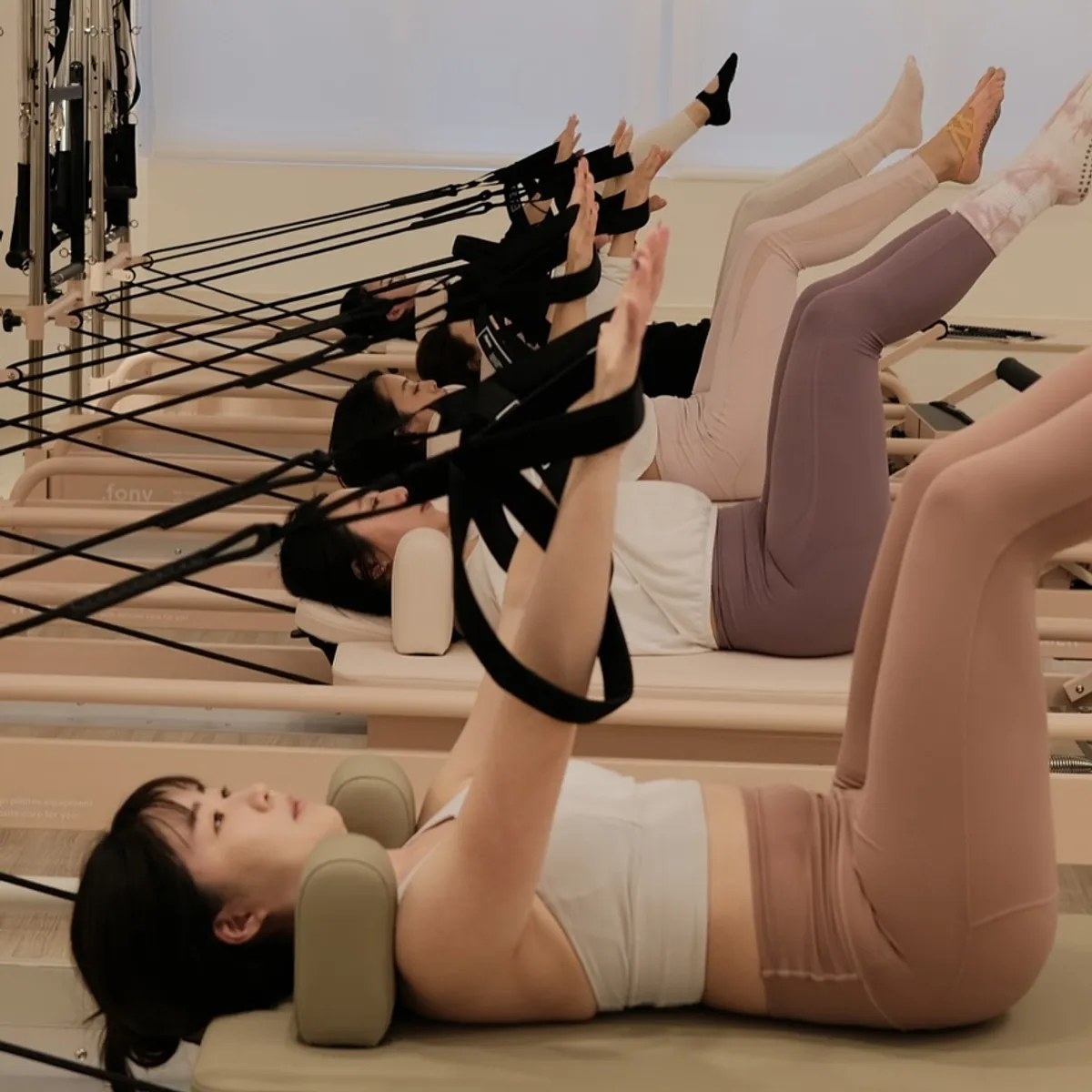
| Reformer Pilates (moderate) | 250–300 |
| Reformer with jumpboard | 375–450 |
| Running 8 km/h | 500–600 |
| Spinning (vigorous) | 500–700 |
If your sole goal is to maximize calories burned per hour, Pilates is not the optimal choice. Running and cycling will always win on raw calorie cost. But raw calorie cost is only one variable in body composition change.
So Why Do People Lose Body Fat Doing Pilates?
Because body composition is not the same as scale weight. A 2015 study by Tinoco-Fernández and colleagues followed 51 women through 10 weeks of mat Pilates without dietary intervention. Scale weight did not change significantly. But waist circumference dropped an average of 4 cm, and lean mass increased measurably.
This is the gap I see in real clients. After 8 to 12 weeks, the scale moves a kilo or two. The mirror moves a lot more. Why?
- More lean tissue, less fat tissue at the same weight. Muscle is denser than fat — one kilogram of muscle takes about 18 percent less volume than one kilogram of fat
- Postural change reads as weight loss. When the pelvis stops tilting forward and the rib cage stops jutting out, the abdomen visually flattens before any fat is lost
- Improved core control reduces visceral bloating. Clients consistently report flatter morning bellies within 4 to 6 weeks
- Better proprioception leads to better food awareness. This is the least measurable but most common pattern I observe — people who train Pilates regularly tend to eat more intentionally without consciously dieting
What Actually Works for Weight Loss?
A caloric deficit. That is the only mechanism by which fat loss occurs, and no form of exercise overrides this. The 2022 American College of Sports Medicine guidelines are explicit: weight loss requires 150 to 250 minutes of moderate-intensity activity per week, ideally combined with a daily caloric deficit of 500 to 750 kcal through nutrition.
What this means in practice for someone who wants both scale change and body composition change:
- Cardio creates the deficit. Walking, running, cycling, swimming — anything that gets your heart rate to 60 to 70 percent of max for 30 to 45 minutes, 3 to 5 times per week
- Pilates reshapes what is underneath. Two to three Pilates sessions per week protect lean mass during the deficit and remodel posture
- Nutrition does most of the actual fat loss. You cannot out-train a poor diet, and you should not try to
This is the combination I see produce the most durable results in my own clients. Pilates plus walking 8,000 to 10,000 steps daily plus a moderate protein-forward diet (1.2 to 1.6 g protein per kg body weight) — for someone training 8 to 12 weeks, this consistently produces 3 to 6 kg of fat loss with visible muscle definition.
What I Have Seen in 10 Years of Teaching
A pattern I want to name out loud: the clients who lose the most weight at my studio are almost never the ones who started with weight loss as their stated goal.
The weight-loss-focused clients typically push too hard, get frustrated by the scale in week three, and quit. The clients who lose meaningful weight are usually the ones who came to fix back pain, prepare for golf, or recover from postpartum. They train consistently because the goal is functional. Body composition changes as a side effect of that consistency.
This is not motivational poster talk. It is what shows up in my retention data. Clients who frame training around capability — I want to deadlift my child without pain, I want to play 18 holes without stiffness — train twice as many sessions per year as clients who frame training around appearance. And the irony is they end up looking better too.
How to Build a Realistic Pilates-Based Weight Loss Plan
If weight loss is your goal and you want Pilates to be part of it, here is the structure I would actually recommend:
Weeks 1-4: Build the habit
- 2 Pilates sessions/week (preferably reformer to learn movement patterns under controlled load)
- 8,000 daily steps minimum
- Track protein intake (do not restrict calories yet — get the habit first)
Weeks 5-12: Add the deficit
- 2-3 Pilates sessions/week
- 3 cardio sessions/week (30-45 min, moderate intensity)
- 10,000 daily steps
- Moderate caloric deficit (15-20 percent below maintenance)
Beyond week 12: Maintain or recomp
- Continue training pattern
- If you have hit your goal weight, transition out of caloric deficit
- Add advanced Pilates progressions for continued strength development
This is not the fastest possible weight loss plan. It is the version that is most likely to still be your routine two years from now, which is the actual point.
The Wider Frame
The longer I teach, the more skeptical I become of diet as an end goal. Twelve-week transformations look great in marketing photos and produce remarkably little long-term change. What I see produce real change is the slower thing — clients who reorient around moving well, eating consciously, and showing up consistently, and who notice over a year or two that the scale has quietly settled in a healthier place.
Pilates is genuinely useful for body composition. It is genuinely not magic. If someone promises you it is, they are selling you something. If you want a sustainable practice that gradually rebuilds how your body looks and moves, you have come to the right place.
If you are weighing how to combine Pilates with the rest of your training, check our programs or reach out via Instagram — happy to help you think through it.
Frequently Asked Questions
Can you actually lose weight doing only Pilates?
On the scale, only modestly. A 50-minute reformer class burns roughly 175 to 375 calories depending on intensity — less than running or HIIT. But studies show 8 to 10 weeks of consistent Pilates reduces waist circumference and body fat percentage even when scale weight barely changes. If your goal is a lower number on the scale, you need a caloric deficit. If your goal is a leaner-looking body, Pilates is one of the most effective tools.
How many calories does Pilates burn in one class?
A 50-minute beginner mat Pilates class burns around 175 calories for a 70 kg adult. The same length reformer class burns 250 to 300 calories at moderate intensity, and an advanced reformer or jumpboard class can reach 375 to 450 calories. Compare this to running at moderate pace (around 500 to 600 calories per hour) — Pilates is not a high-calorie burner, but its effect on body composition is disproportionate to its calorie cost.
Should I do cardio or Pilates for weight loss?
Both, in that order of priority if scale weight is your goal. Cardio creates the caloric deficit needed for fat loss; Pilates reshapes your body composition and protects you from the muscle loss that comes with cutting calories. The 2022 ACSM guidelines recommend 150 to 250 minutes of moderate cardio per week for weight loss, paired with 2 to 3 resistance sessions. Pilates can serve as your resistance work.
How long until I see results from Pilates?
Posture changes are visible to others around weeks 4 to 6. Core strength and movement quality shift around 6 to 8 weeks. Visible body composition change — leaner waist, more defined arms and legs — typically takes 10 to 12 weeks of training 2 to 3 times per week, paired with consistent nutrition. If you are training only once a week, expect to roughly double these timelines.
Why do some people say Pilates transformed their body in 30 days?
Usually one of three reasons: they also changed their diet, they were sedentary before so any movement produced rapid change, or the visible change is mostly posture and water retention rather than fat loss. Real fat loss requires a sustained caloric deficit over weeks — there is no exercise method that bypasses this. Be skeptical of any 30-day transformation claim that does not also mention nutrition changes.
Transform Your Movement, Transform Your Life
From Golf & Running Pilates to barre n yoga — discover programs designed by a sports science expert.