Pilates After 40: A Science-Backed Guide for Perimenopause, Menopause, and Beyond
A friend asked me last year, somewhere around her 47th birthday: “What is happening to my body? I’m doing the exact same things I always did, and everything has changed.”
I have had some version of that conversation many times, with members in my studio and in conversations with friends. The honest answer is that yes, after 40, the body really does change faster than it changed in any previous decade. Muscle loss accelerates. Estrogen drops. Connective tissue stiffens. Bone density falls. Recovery slows. Joints become less forgiving of high-impact training.
The good news, which I want to be very clear about: this is the decade Pilates was practically invented for. Joseph Pilates himself was still doing his full workout into his 80s. The method holds up across the lifespan in a way that running, HIIT, and traditional weight training do not. This guide is the conversation I have with every new client over 40 at mm Pilates.
What Actually Changes in the Body After 40?
Several things, in roughly this order:
Sarcopenia begins to accelerate. Adults lose about 3-8% of muscle mass per decade after 30, but the rate roughly doubles after 60. By 80, many sedentary adults have lost 30-40% of the muscle they had at 30. Pilates resistance training has been shown to slow and partially reverse this trajectory.
Estrogen declines through perimenopause. Starting in the mid-40s for most women, estrogen production falls erratically before stabilizing at low levels after menopause (typically 51-52). This affects bone density, ligament laxity, body fat distribution, joint inflammation, sleep, and mood.
Bone density loss accelerates. Women can lose up to 20% of bone density in the 5-7 years around menopause (NIH, 2022). Without intervention, this trajectory leads to osteoporosis and fragility fractures.
Connective tissue stiffens. Tendons and fascia become less elastic, increasing injury risk during sudden movements. This is why “I bent down to pick up the laundry” injuries become common in the 50s.
Recovery slows. The same workout that was unremarkable at 35 now produces 48-72 hours of soreness instead of 24. This is real and physiological, not a sign of weakness.
None of this means decline is inevitable. It means the training stimulus has to change.
Why Pilates Is Uniquely Suited to This Decade
Pilates addresses the specific physiological changes of midlife more precisely than almost any other movement modality. Here is why I have seen it work so consistently with clients in their 40s, 50s, and 60s.
1. It Loads Muscle Without Pounding Joints
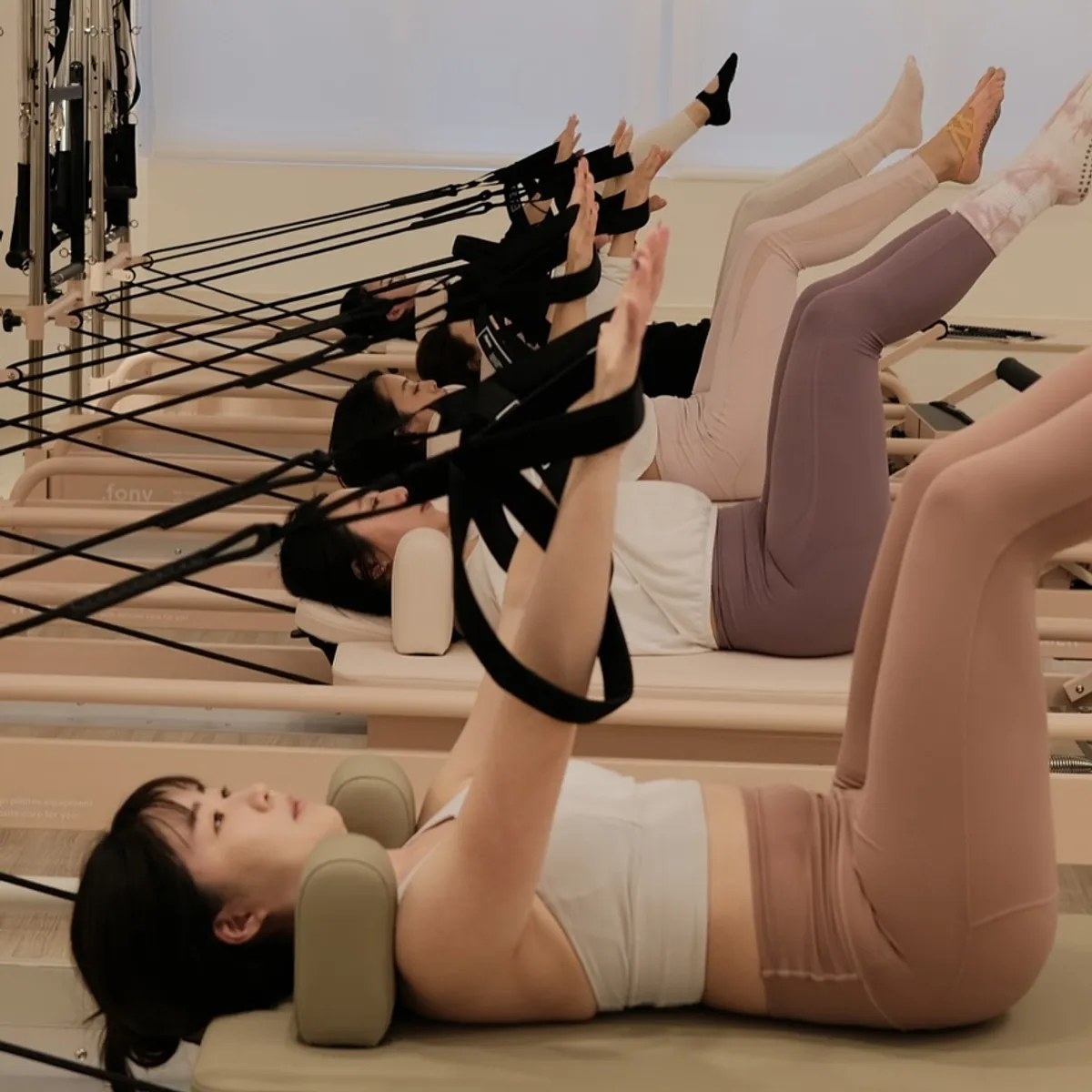
Pilates uses spring or bodyweight resistance — no impact, no jarring, no compressive load on already-vulnerable joints. The reformer especially can be calibrated session by session to the body you have today. On a high-cortisol week, you train lightly. On a strong week, you increase springs. This adaptability is exactly what the perimenopausal body needs.
2. It Builds Bone Through Resistance and Alignment
The bone-loading literature is clearer than most people realize: weight-bearing exercise stimulates bone formation, but only when the load is sufficient and the alignment is correct. A 2015 study by Angin and colleagues followed postmenopausal women through 12 weeks of Pilates and found measurable improvements in lumbar spine bone mineral density. The mechanism is the consistent axial loading of the spine in a controlled, well-aligned position — something Pilates does in nearly every exercise.
3. It Strengthens the Pelvic Floor
Pelvic floor weakness affects approximately 50% of women over 50 (Wu et al., 2014). Estrogen decline reduces pelvic floor muscle tone, and the consequences — stress incontinence, prolapse risk, sexual function changes — are common but rarely discussed openly.
Pilates trains the deep core in coordination with the pelvic floor, which is the system’s natural pattern. A 2010 study by Culligan and colleagues showed that 24 sessions of Pilates produced pelvic floor strength gains equivalent to traditional Kegel-only programs — with the added benefit of training the surrounding musculature. For women navigating perimenopause, this is non-negotiable training.
4. It Trains Balance and Fall Prevention
Falls are the leading cause of injury death in adults over 65 (CDC, 2023). The risk begins climbing in the late 50s. Pilates trains proprioception, ankle stability, hip rotators, and core control — the exact systems that prevent the loss-of-balance moment that causes falls. Bird and colleagues’ 2012 meta-analysis confirmed Pilates significantly improves dynamic balance in older adults.
5. It Supports Hormonal Wellbeing Indirectly
Pilates does not change hormone levels directly, but the mechanisms it influences — sleep quality, cortisol regulation, mood, body composition — are all amplified by hormonal change in midlife. A 2018 study found 8 weeks of Pilates significantly improved sleep quality and reduced depression scores in perimenopausal women. This is a real, measurable benefit independent of any physical adaptation.
What This Looks Like in Practice: A Decade-by-Decade Map
Here is the progression I use with clients, adjusted by health status of course.
| Decade | Primary focus | Recommended cadence |
|---|---|---|
| 40s (perimenopause) | Build muscular reserve, learn movement quality, establish habit | 2-3x/week Pilates + 2-3x/week cardio |
| 50s (menopause transition) | Bone density, pelvic floor, joint mobility, sleep | 3x/week Pilates + daily walking |
| 60s | Balance, functional strength, fall prevention, hip and shoulder mobility | 2-3x/week Pilates (often reformer-only) |
| 70s+ | Maintain independence, prevent fragility, reduce stiffness | 2x/week supervised Pilates + daily mobility |
What I want to emphasize: the quality of the movement matters more in this decade than at any other point in life. A poorly executed exercise that aggravates the lower back is not just unproductive — at 55, it can take 6 weeks to recover from instead of 3 days. The cost of bad form rises sharply with age. This is why I push private or small-group sessions for first-time clients over 50.
What to Emphasize, What to Skip
After teaching dozens of midlife clients, these are the patterns I consistently program in or out.
Prioritize:
- Spinal extension work (counters the forward-slumping pattern that worsens with age)
- Hip mobility and glute strengthening (the most common weakness in this demographic)
- Side-lying and standing work (load the bones in non-routine planes)
- Single-leg stability (directly correlates with fall risk reduction)
- Slow, controlled eccentric movements (preserve and build tendon resilience)
Modify or skip in most cases:
- Loaded spinal flexion (full roll-ups, the hundred with head lifted, teaser) for clients with osteopenia or osteoporosis — these can fracture vertebrae in fragile bones
- Deep neck flexion holds (the classic hundred neck position) — common cervical disc issues in this age group
- High-velocity rotation (twisting on a moving reformer carriage at speed)
- End-range stretching (less protective stretch reflex means easier overstretching)
- Jumping or impact work without specific clearance
A good instructor knows how to substitute. If yours hesitates or says “just do it gentler,” seek out someone with specific training in pre/post-menopausal populations.
What I See in My Studio
The pattern I see most consistently in midlife clients is this: they come in expecting to manage decline and leave realizing they are actually getting stronger than they were at 35.
This sounds like motivational poster talk until you see it. Many of my 50s-and-60s clients can do exercises they could not do at 40 — full back extensions, controlled teasers, 90-second planks — because they have spent 2-3 years training mindfully instead of randomly. They were never strong in the way that mattered. They are now.
The pattern also runs the other way. Members who came in physically capable but never developed body awareness — long-time runners, recreational golfers — often plateau quickly and then regress. Capacity without awareness does not survive midlife. Awareness without much initial capacity often surpasses it.
This is, I think, the deeper reason Pilates fits this decade so well. It is the rare training method where the qualities it builds — precision, control, breath, alignment — actually become more accessible with age, not less. You stop needing to muscle through. You start needing to think through. The body cooperates.
A Personal Note
I am a few years away from the perimenopause window myself, and I have watched my own mother and many friends navigate it. The version that goes well is rarely the one where people grind harder. It is the one where people listen more carefully, train more thoughtfully, and stop pretending the body of 30 is the body of 50.
This is not a defeat. It is a recalibration. And honestly, the women I know in their 60s who are still moving with strength and ease — almost all of them found something like Pilates somewhere in their 40s and stayed with it. The choice you make now compounds for the next 30 years more than any other fitness decision you will make.
If you are figuring out what training looks like for your decade, our programs include private and small-group options well suited to midlife. Or message me on Instagram — I am genuinely glad to help.
Frequently Asked Questions
Is Pilates good for women over 40?
Yes, and increasingly so. After 40 you face accelerating muscle loss (sarcopenia), declining estrogen affecting bone density and connective tissue, and rising injury risk from high-impact training. Pilates uniquely addresses all three: it loads muscle and bone without joint pounding, strengthens the pelvic floor (often weakened in perimenopause), and improves balance and posture — the two strongest predictors of independent aging.
Can Pilates help with menopause symptoms?
Pilates does not change hormones, but it measurably improves symptoms that menopause amplifies. Studies show 12 weeks of Pilates improves sleep quality, reduces depression and anxiety scores, decreases joint pain, and improves pelvic floor function in postmenopausal women. It also helps maintain bone mineral density when paired with adequate protein and vitamin D. It is not a hormone replacement, but it is one of the most evidence-supported lifestyle interventions for menopause.
Is reformer Pilates safe for older adults?
Reformer is often safer than mat for adults over 50 because the springs provide adjustable support and the carriage assists weaker movement patterns. Many of my clients in their 60s and 70s prefer reformer for this reason — exercises that would be unsafe on the floor become manageable with spring assistance. The key is finding an instructor who modifies for joint protection, particularly the wrists, neck, and lower back.
How often should women over 40 do Pilates?
Three sessions per week is the sweet spot for women over 40 who want to address sarcopenia and bone density. Two sessions per week maintains current function. One session per week is largely social — useful for mental health but minimally adaptive at this age. After 50, I also recommend adding 2-3 sessions of walking or low-impact cardio per week, plus adequate protein (1.4-1.8 g/kg body weight) to maximize Pilates’s effect on lean mass preservation.
Can you start Pilates for the first time at 50 or 60?
Absolutely — I have started clients in their 60s and 70s who became some of my most consistent practitioners. Older beginners often progress more steadily than younger ones because they listen to their bodies and avoid the ego-driven pushing that causes injuries. The key is finding an instructor experienced with older populations, starting with private or small group sessions, and committing to twice-weekly attendance for at least 3 months before evaluating progress.
Transform Your Movement, Transform Your Life
From Golf & Running Pilates to barre n yoga — discover programs designed by a sports science expert.